

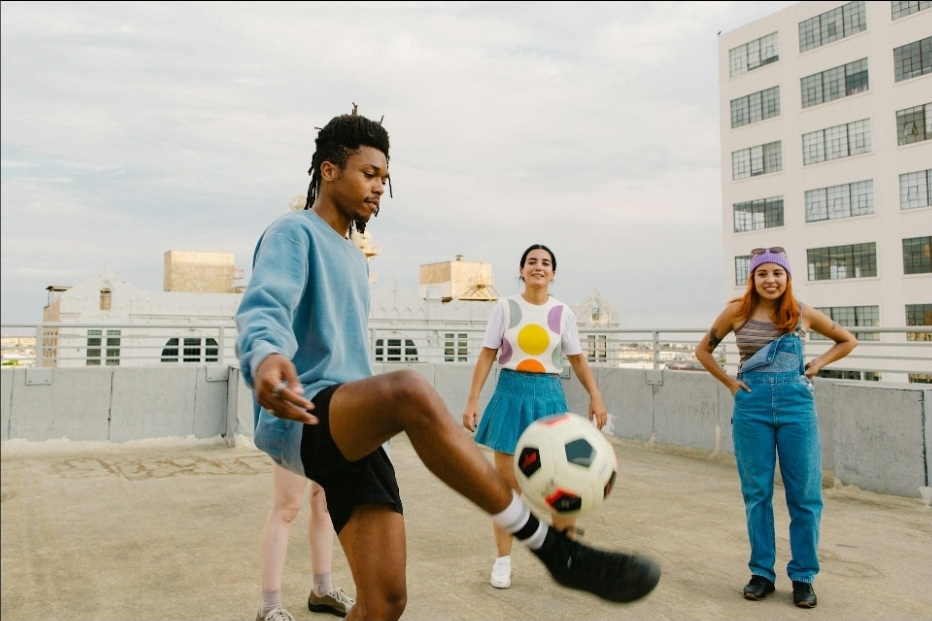
Photo by Lia Bekyan on Unsplash
Football and music occupy unusually large spaces in Nigerian popular culture. One can fill a stadium, the other can fill an arena, but both also travel far beyond their original settings. A major match becomes a reason for parties, playlists and social media conversation, while a new song can quickly become associated with a player, club or tournament.
That overlap is not accidental. Both football and music depend heavily on shared emotion, identity and memorable moments. Nigeria has produced songs specifically celebrating the Super Eagles, while musicians and footballers increasingly appear in the same wider entertainment conversation. HighlifeNG itself has featured tracks dedicated to the national team, including Tony Oneweek’s “Super Eagles (Champion)” and Majeeed’s AFCON themed “Let’s Do It Again.”
Football Has Always Needed a Soundtrack
Think about the atmosphere surrounding an important match and music is rarely far away. Songs play before kickoff at viewing centres, from car speakers on the way to meet friends and during celebrations if the result goes well. Even without an official tournament anthem, supporters tend to create their own soundtrack.
Music can also give a football moment a longer life. A tournament eventually ends, but a song associated with it may bring back memories years later. The opening notes can instantly recall a goal, a celebration or the atmosphere around a national team campaign.
Nigeria has a particularly visible tradition of connecting music with the Super Eagles. Austino Milado, for instance, released several songs associated with the national side, while more recent artists have continued producing tournament themed music. That continuity shows that the connection is not simply a modern marketing strategy.
Matchday Is Now a Wider Entertainment Occasion
For many supporters, a big football match occupies much more than the ninety minutes on the pitch. Friends may arrange where to watch several hours beforehand, music sets the atmosphere, group chats become active and post match plans often depend on the result.
Digital entertainment has added still more options around that routine. Fans can follow team news, check statistics, discuss lineups and move between different platforms before and during a game. For adults who choose to include betting in that experience, sports betting online is another part of the wider matchday environment. Betano Nigeria currently offers football markets before kickoff and during live matches across multiple competitions.
Betting is only one optional part of that broader picture. The more interesting cultural change is that watching football no longer means simply turning on a television at kickoff. The match sits within several hours of conversation, music and digital activity.
Nigeria’s Rivalries Extend Far Beyond the Pitch
Some football rivalries become powerful precisely because they are connected to wider questions of culture and identity. Nigeria and Ghana provide one of Africa’s clearest examples.
ESPN has described the Nigeria versus Ghana rivalry as extending beyond football into areas including music, food and culture. That is why encounters between the two countries can feel bigger than an ordinary international fixture.
Arguments about football can sit beside debates about artists, food and popular culture, often with the same mixture of competition and humour. A result on the pitch temporarily gives one side another piece of evidence in a rivalry that is already being played out elsewhere.
Football works particularly well in this environment because it provides a clear result. Music does not produce a scoreboard, but supporters can still debate which country has the stronger artists or greater cultural influence with almost the same intensity.
Players Have Become Part of Entertainment Culture
Modern footballers are also far more visible away from the pitch than previous generations were. Social media allows players to show their music tastes, fashion choices, friendships and everyday personalities directly to supporters.
That creates obvious connections with entertainment. A footballer can appear at a concert, share an artist’s song or participate in a viral dance and immediately reach an audience that extends beyond dedicated sports fans.
The relationship moves in the opposite direction too. Musicians regularly show support for clubs and national teams, attend major matches and reference football in songs or social media posts. These moments work because the audiences already overlap.
It is increasingly difficult to separate the football celebrity from the wider entertainment celebrity. Both exist within the same online culture, where sports, fashion and music appear side by side on the same feed.
Goals and Songs Share the Same Social Spaces
A generation ago, football conversation was more dependent on television, radio and face to face discussion. Music distribution relied more heavily on physical media and conventional broadcasting. Smartphones have changed both industries at the same time.
A spectacular goal can become a short video shared thousands of times within minutes. A new track can spread through dance clips, memes and fan edits just as quickly. Put the two together and a football moment can suddenly acquire its own soundtrack.
This explains why certain songs become associated with players even when there is no official relationship between them. Fans choose music for edits, celebration clips and compilations, and repetition can make the association feel permanent.
Football therefore helps music travel, while music gives football moments another emotional layer. Neither industry needs to formally organise the crossover for it to happen.
Viewing Centres Make the Connection Especially Visible
The relationship between football and entertainment becomes particularly obvious when supporters watch together. A viewing centre is not simply a place where a screen happens to be showing a game.
People arrive before kickoff, conversations build and music can fill the quieter periods before the match begins. Half time creates another break, while the final whistle may either extend the celebration or rapidly change the mood.
That social experience is difficult to reproduce when watching alone. The collective reaction to a goal, missed chance or controversial decision becomes part of the entertainment itself. Music helps connect those different stages of the evening. It fills the periods when the ball is not moving and can turn a match into a much longer social occasion.
National Team Football Creates Different Emotions
Club football may dominate the calendar, but national team matches can produce a broader kind of cultural participation. People who rarely discuss league football may still follow the Super Eagles during an important tournament.
Music naturally expands with that audience. A national team song does not require detailed knowledge of tactics or club rivalries to work. Its purpose is often simpler, to create excitement and express collective support.
HighlifeNG’s catalogue provides a good illustration. Songs celebrating the Super Eagles appear alongside highlife, Igbo music, hip hop, gospel and other genres, showing how easily football enters music spaces rather than remaining confined to sports media.
When Nigeria progresses deep into a tournament, that crossover becomes even more visible. Football becomes a national entertainment story, and music gives supporters another way to participate in it.
The Connection Works Because Both Depend on Emotion
Statistics can explain football tactics and technical analysis can describe how a song was produced, but neither fully explains why people become attached to them. A winning goal matters because of the emotion surrounding it. A favourite song matters for much the same reason. Both can become connected to a particular place, group of friends or period of life.
That is why football and music fit together so comfortably in Nigerian entertainment culture. They are social experiences before they are anything else, and both become more powerful when shared.
The platforms surrounding them will continue changing, and matchday habits will evolve with technology. The basic connection, however, is much older and simpler. When a big match creates a moment worth remembering, music is rarely very far away.
+15856533044, +15856533044

-
 Nkama SamuelDedicated Support
 -
 Ezugwu EjikeSocial Support
 -
 Okoli JonathanAdmin