


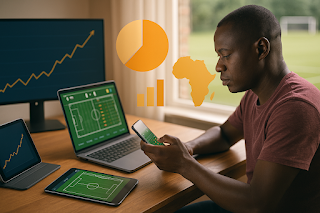
Betting in Africa has moved from informal street predictions to organised, regulated sectors shaping national economies. Long ago, local pools operated through physical shops and community circles. With the growth of mobile technology, digital betting now supports entire networks of data suppliers, developers, and tax systems.

Economic observers often link the digital expansion of betting platforms with financial inclusion. Many players create verified profiles to track funds and taxes correctly. The use of 1xbet login registration illustrates this modern shift – it connects entertainment to structured regulation, making transactions traceable and transparent. This combination of accessibility and supervision supports both growth and accountability.
The story of African betting runs parallel with wider digital transformation. Mobile money, improved internet coverage, and youthful demographics created a unique ecosystem. In this environment, betting plays both an economic and social role by fuelling digital payment systems and new employment categories.
Betting as a new economic driver
In the past twenty years, betting has become part of Africa’s expanding service economy. It interacts directly with technology, sport, and finance. Economists estimate that in several sub-Saharan nations, betting-related taxes already form between 0.5% and 1.5% of total GDP. The figure may rise as mobile integration deepens.
The sector generates value beyond direct taxation:
- Employment in IT, design, and customer service
- Growth of fintech solutions supporting instant deposits
- Sponsorship deals with domestic sports leagues
- Data collection improving analytics and market forecasting
This diversity shows that betting functions not as a closed system but as a catalyst for related industries.
Technology and market structure
The biggest change lies in digital processing. A decade ago, many bettors relied on SMS or manual slips. Now, cloud-based software records every transaction. Platforms handle millions of micro-payments daily, stimulating innovation in mobile banking and cybersecurity.
Economic researchers point to the multiplier effect of regulated gaming. Each technical update brings indirect benefits such as new coding jobs, marketing roles, and call centre operations. Analysts also note that mobile regulation has helped combat financial exclusion by encouraging low-income citizens to open digital wallets.
The role of culture and sport
Sports betting remains the heart of the industry. It connects entertainment to measurable statistics and social identity. Fans use predictions to analyse games, discuss tactics, and share community knowledge.
Across regions, football dominates transactions, followed by basketball and athletics. The intersection between sport and technology creates local digital ecosystems. Within these, sports in East Africa play a special role, driving cross-border sponsorships and fan engagement.
Governments increasingly treat sports betting as part of creative. That shift encourages formal employment and predictable taxation.
Public policy and infrastructure growth
National authorities recognise betting as a potential tax base that can fund broader infrastructure. Licensing systems and compliance departments regulate transparency. When implemented correctly, these frameworks limit informal operations and keep revenue within the country.
Successful examples show that structured licensing improves GDP through:
- Predictable tax collection cycles
- Encouragement of local entrepreneurship
- Partnerships between regulators and private technology firms
In this way, betting becomes not only an activity but also a revenue source for digital public services.
The social-economic chain behind betting
Each betting transaction contributes to a larger value network. Payment providers, network operators, software developers, and tax authorities benefit collectively. As systems become more automated, costs fall and participation increases. The result is circular growth – each player in the chain reinforces another.
The most visible outcome is formal employment. Call centres, streaming companies, and content creators now depend partly on the betting economy. This interconnection keeps funds circulating inside national markets rather than leaving through unregulated channels.
Future directions and steady expansion
The African betting market continues to mature. Its integration with modern payment systems turns entertainment into measurable GDP contribution. Economists now study how digital betting complements financial inclusion and strengthens consumer confidence in online transactions.
Many African countries show steady year-on-year increases in tax revenue linked to the gaming sector. Behind each percentage point lies thousands of micro-interactions, each contributing to the wider economy.
The story of betting and GDP in Africa reflects more than numbers. It shows how technology, culture, and regulation merge into a shared structure of growth. As the continent modernises, betting remains one of the industries that demonstrate how local innovation can meet global standards without losing identity.


+15856533044, +15856533044

-
 Nkama SamuelDedicated Support
 -
 Ezugwu EjikeSocial Support
 -
 Okoli JonathanAdmin